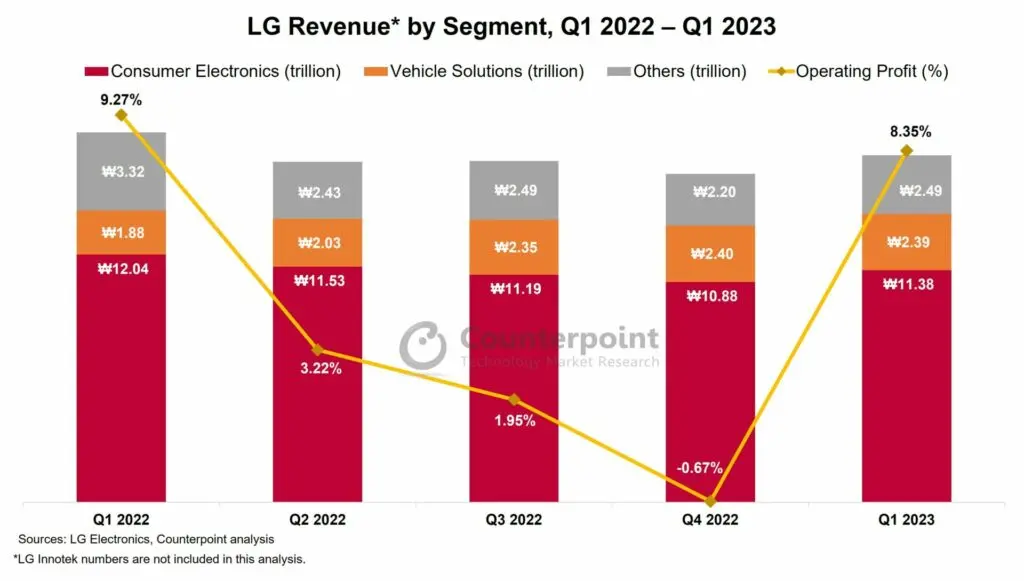
- The revenue for Q1 2023 stood at KRW 16.26 trillion, a 5.7% YoY decline.
- The operating profit of the company declined by 15% YoY.
- The revenue from the vehicle solutions segment grew 27% YoY to reach KRW 2.4 trillion.
LG Electronics has generated relatively steady Q1 2023 earnings results thanks to the stabilization of material costs and the continued sales of high-end home appliances. The heat pumps and energy storage devices helped it earn more as the climate change restrictions tightened.
The company’s revenue declined 5.7% YoY in Q1 2023 to KRW 16.26 trillion ($12.75 billion), while the operating profit declined 15% YoY to KRW 1.36 trillion ($1.06 billion) owing to sluggish global demand. Although the profit dropped YoY, it was a considerable improvement over the losses in the previous quarter.
The business portfolio is experiencing growth through qualitative measures, particularly in expanding B2B segments such as vehicle components and system air conditioners. Besides, non-hardware business revenue continues to increase. The vehicle component solutions segment raked in high profits, contributing almost 15% to the total revenue, up from 11% in Q1 2022.
Financial highlights
- The consumer electronics segment’s revenue fell 5.5% YoY to reach KRW 11.38 trillion ($8.9 billion). However, the operating profit increased by 92% owing to lower logistics costs, efficient management of raw material supply, improved spending efficiency and active measures to enhance cost structure. The contribution of this segment to LG’s Q1 operating profit rose to 89.7% from 40% in Q1 2022.
- The revenue of the vehicle solutions segment grew 27.1% YoY to reach KRW 2.39 trillion ($1.87 billion) driven by high order backlogs and the electric vehicle (EV) boom in the automotive market. Supply chain management improvements for key components, like semiconductors, played a crucial role. The operating profit grew to KRW 54 billion ($42.3 million), compared to the loss of KRW 6.7 billion ($5.6 million) in Q1 2022. Although the segment contributed just 4% to LG’s Q1 operating profit, it is touted as the future growth driver.
- Revenue from other businesses, which include business solutions, kept declining YoY to reach KRW5 trillion ($1.95 billion), falling 25%. The operating profit dropped 91% YoY to KRW 85 billion ($66.7 million). The segment’s contribution to LG’s Q1 operating profit was only 6.3% compared to 61% in Q1 2022.
- LG Innotek’s revenue grew 10.7% YoY to KRW 4.4 trillion ($3.43 billion). The operating profit decreased by 60.4% to KRW 145 billion ($114 million). This brought LG’s consolidated revenue to KRW 20.4 trillion ($16.01 billion).
Market outlook
Amid declining consumption due to economic downturn concerns, consumer electronics revenue is expected to fall while profits will remain sluggish in the next quarter. The decreasing IT demand will also have negative impacts on yields. The huge order backlog (KRW 80 trillion) and the ongoing transition to EVs will drive the vehicle solutions segment revenue. Based on the high growth within EV markets, it is expected that the EV component business will continue to take up a larger share in the future. A reliable portfolio of in-car infotainment systems, e-powertrain, headlights and unique solutions will maintain LG’s competitive advantage.
LG Electronics is going aggressive on increasing its technological advantage over competitors. This year, the company plans to invest over KRW 5 trillion ($4 billion) in its most significant capital expenditure in 10 years, mainly in the automotive electronics business. This move aligns with the business strategy of focusing on long-term growth and prosperity. The R&D spending has also been increased by 10% this year. LG wants to sustain growth and ensure consistent profitability by proactively and adaptively addressing shifts in demand across various regions and segments. It also aims to expand eco-friendly enterprises in pursuit of revenue growth through energy-efficient and environment-friendly products.
*LG Innotek’s numbers are not included in the total revenue and have been mentioned separately.
Related reports
- Counterpoint Macro Index: March 2023
- UMC Q1 2023 Earnings: Weak Cyclical Recovery But 28nm Remains Resilient
- Price Cuts Boost Tesla Revenue in Q1, Profit Slumps Compared to 2022
- Q1 2023 Global PC Shipments Mark Another Quarterly Decline, Gradual Recovery Expected in H2
- Arm-based PCs to Nearly Double Market Share by 2027
- LG Electronics Operating Profit Stumbles in Q4 2022
- LG’s Automotive Electronics Business Profile
- Good Show in Vehicle Solution, B2B Segments Helps LG Fight Macro Headwinds
- LG Electronics Revenue at New Record High in Q1 2022


