

- The global smartphone ASP is expected to grow steadily to reach $412 by 2029 from $370 in 2025 with a CAGR of 3%, showing steady normalization after recent volatility.
- Annualized global smartphone revenue is expected to reach $564 billion by 2029, growing at a 5% CAGR from 2025 to 2029.
- GenAI integration, easing tariff volatility, and regional market dynamics together point to a positive ASP outlook through 2029.
- In 2025, North America’s ASP is projected to rise 7% YoY despite an expected slowdown in H2 shipments, while China’s ASP is projected to grow 3.6% YoY, led by premium models.
- Apple remains the anchor of premium ASPs, rising from $919 in 2025 to nearly $1,000 by 2029, driven by Pro adoption in developed and volume in emerging markets.
The global smartphone market’s average selling price (ASP) continues to grow year after year, driven by premiumization. From $357 in 2024, the market’s ASP is projected to reach $370 by 2025 and $412 by 2029, a CAGR of 3%, according to Counterpoint Research’s Market Outlook Tracker. Apart from increasing premiumization, this steady growth is also supported by 5G adoption and consumer preference for advanced features, even in mid-range devices.
Looking at Q2 2025, the market has behaved far more normally than many feared. Counterpoint Research’s latest forecast sees global smartphone shipments rising 2.5% YoY in 2025, up from the 1.9% growth rate forecasted in Q1, but down from the 4% rate projected at the beginning of the year. The reasons for the shipment slowdown are price increases, supply chain realignment and macroeconomic pressure. The 2025 ASP is set to rise 3.5% YoY to $370, slightly higher than the previously expected 2.3% increase, driven by rising ASPs in North America and a rebound in prices in India and the rest of APAC, supported by recovering economic conditions. With ASPs rising faster than shipments, the combined uplift is set to drive smartphone revenues up by nearly 6% YoY in 2025. Over the longer term, this momentum is expected to sustain a 5% CAGR in revenues through 2029 from 2025 to reach an annualized global smartphone revenue of $564 billion.
Global Smartphone Market Average Selling Price (ASP) Forecast, 2022 - 2029
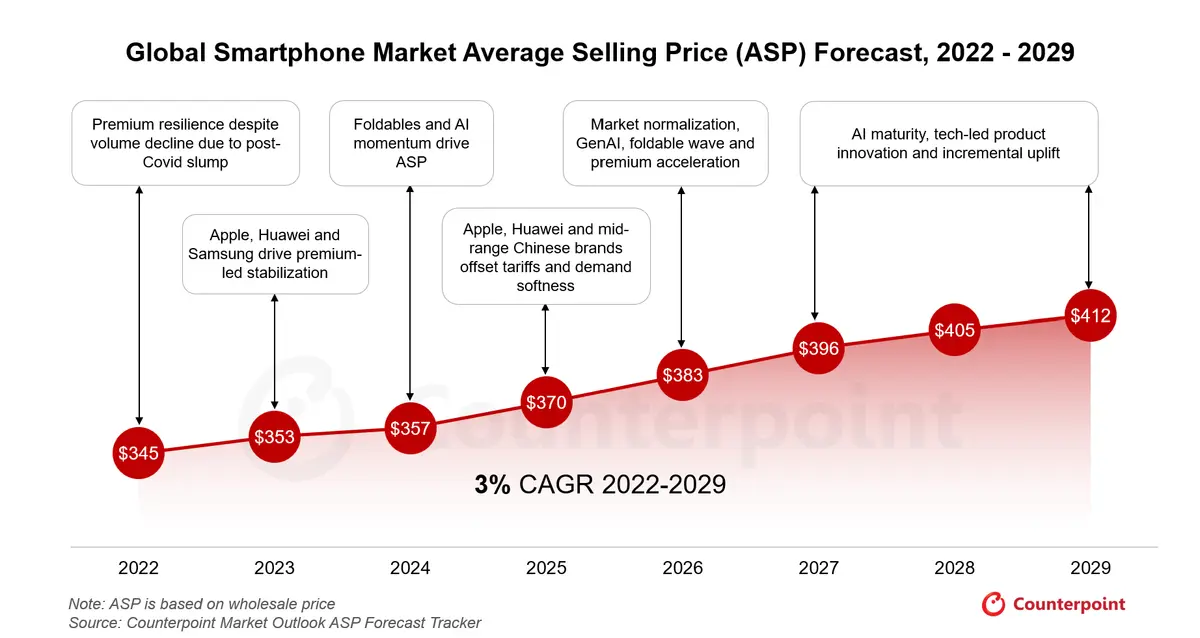
After years of disruption, from pandemic-era demand swings to supply chain challenges to recent tariff-induced volatility, the smartphone market is beginning to normalize. US operators continue with aggressive promotions, inventories have not piled up, and OEMs have stuck to their regular launch cycles and procurement strategies. The smartphone market outlook suggests a more ‘normalized’ market through H2 2025 and into 2026, reinforcing our forecast that ASP growth and stable volumes will sustain revenue expansion. Smartphones have so far been largely exempted from increases in tariffs levied by the US against trade partners and are relatively insulated compared to sectors like automobiles, semiconductors and other consumer electronics. However, trade uncertainty due to US tariffs, along with a softer macroeconomic environment, could yet complicate the situation at a future point.
North America’s shipments are expected to drop in H2 2025 after a strong H1 front-loading, while tariff pass-through will lift the overall ASP by 7% YoY in 2025. Apple’s premium models, continuous promotions from mobile operators, and foldables are expected to lift the ASP to around $984 by 2026. In the longer term, the US will play a stabilizing role in keeping the global ASP elevated, but its contribution to ASP growth through 2029 will be more incremental as it is already a premium market. We do not expect another sudden increase due to the trade environment, as additional hikes will be absorbed by vendors, distributors and consumers alike.
In China, our Q2 2025 forecast indicates a slightly lower ASP trajectory than Q1, with smartphone ASP growth revised to 3.6% YoY in 2025 from the earlier 4% estimate. The ASP is mainly driven by Huawei, OPPO and vivo. Apple’s China ASP is now expected to grow by 2% YoY in 2025 compared to the prior Q1 forecast, which had projected a decline. This improvement in ASP is largely driven by better sales of Pro models, despite a slight decline in shipments. In the longer term, China’s premium shift will push global ASP to the higher side while increasing its role in the global smartphone market’s premium segment.
India will continue to support the mid-range segment, with its ASP remaining below $250 in 2025 but gradually increasing amid premiumization to reach $287 by 2029. Continued migration from feature phones, rising demand in rural and semi-urban areas, and growing digital adoption will provide steady momentum for both mid-range and premium smartphones.
Apple remains the anchor of premium ASPs, projected to rise from $919 in 2025 to nearly $1,000 by 2029, driven by its mix of Pro and base models, including the latest “e” and “Air” lineup. The iPhone 16e led to a 9% YoY ASP contraction in Q1 2025, but the ASP is expected to improve with Pro model adoption in H2 2025. Apple is intentionally pursuing a dual strategy – on the shipment side, it is broadening its base, with the iPhone e and iPhone Air tapping into emerging markets and consumer segment, while on the ASP side, Apple is reinforcing its high-end dominance with Pro models while preparing for an uplift from its first foldable in 2026. In the longer term (2026-2029), the US, China and Europe will continue to hold the highest share for Apple, while price-sensitive markets LATAM, MEA and India will witness higher YoY shipment growth driven by the iPhone’s base models and older-generation models.
ASP Forecast, CAGR for Major Global Smartphone Brands, 2025-2029

Source: Counterpoint Market Outlook ASP Forecast Tracker
Samsung’s ASP profile will remain steady. Weak flagship performance in H1 2025 will lower its overall ASP for 2025, though foldables and GenAI adoption will support long-term growth. On the other hand, Samsung’s significant exposure to the mid-tier segments in emerging markets will limit the ASP growth potential. Other Android players, like Xiaomi, OPPO and vivo are pursuing a premiumization strategy too, but weak demand in China and modest performance in India kept the ASP growth largely modest in 2025.
After its resurgence, Huawei is strengthening ASP growth in its home market, China. With easing supply chain constraints over its self-developed chips, Huawei’s Mate and P series are helping pull its ASP upward. The ASP is further supported by Huawei’s strong foldable adoption, which is getting good traction. HarmonyOS loyalty enables premium pricing, though expansion beyond China remains limited.
In 2024-2025, the emergence of GenAI smartphones led to an uptick in Bill of Materials (BoM) costs by around $40-$60 per device, which initially lifted prices. As AI matures, ASP growth will shift from cost inflation to perceived value, as consumers will be more willing to pay for AI-first devices.
While foldable smartphones still account for under 2% of global shipments, their ASPs are pulling averages higher and shaping consumer perceptions toward premium. The expected foldable from Apple in late 2026 could trigger an ASP bump, while resetting the industry’s foldable benchmark.
Taken together, the global smartphone ASP forecast looks slightly positive. Tariff volatility is fading now, supply chains are stabilizing, and the balance of premium smartphone adoption, GenAI and foldable innovation will keep a modest upward momentum. The growth is not going to be explosive, but normalized, where smartphone ASPs will steadily climb despite macro headwinds.

