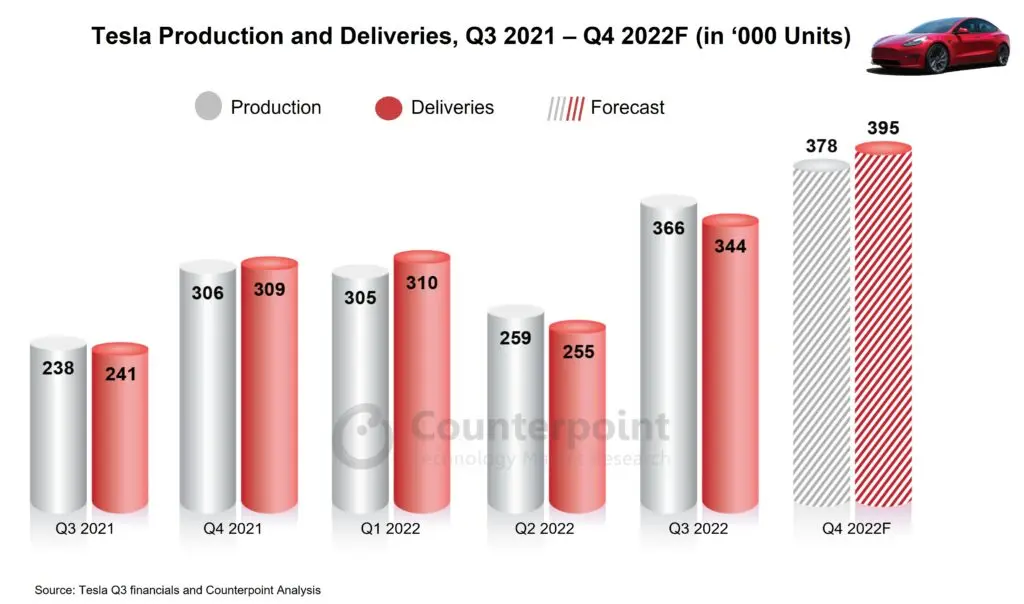
- Tesla delivered nearly 343,900 vehicles during Q3 2022, an increase of 42.4% YoY
- Logistics remains a major bottleneck for Tesla deliveries
- Tesla can exceed 1.3 million unit deliveries by year end with current trajectory
Tesla rebounded during Q3, after experiencing a relatively weak second quarter. During Q3, Tesla delivered nearly 343,900 vehicles, a 42.4% annual increase and a sequential increase of 35%. The combined deliveries of Model S and Model X grew by more than 100% YoY, reaching 18,670 units, while the combined deliveries of Model 3 and Model Y increased by 40% YoY. China is the leading market for Tesla followed by the USA and Europe.
Tesla’s Shanghai Gigafactory surpassed the previous quarterly production rate and remains the main export hub supplying to most markets outside North America. The gigafactory updated its production ramp in July this year. The Berlin Gigafactory is also producing more than 2,000 units of Model Y, weekly. A lot of work is left to bring the Berlin plant to full capacity as it is only slowly reaching its planned output. As winter approaches, and it is feared that Europe will experience an energy crisis, Musk somehow remains optimistic about vehicle production in the Berlin plant and expects that no production cuts will happen.
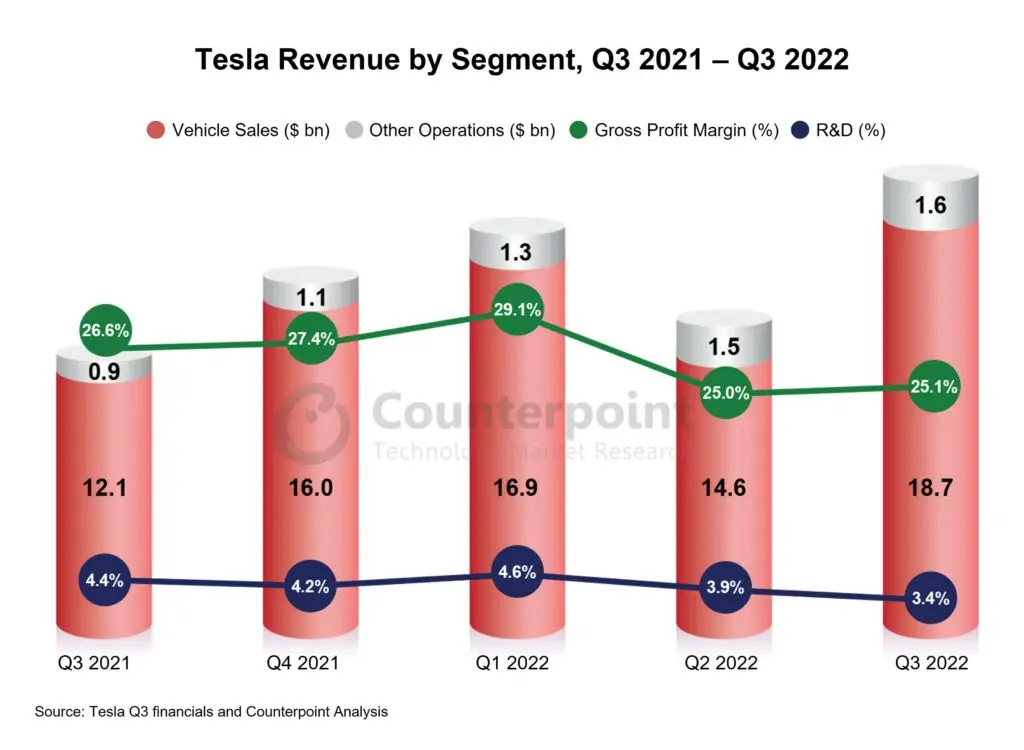
Q3 financial summary:
During Q3, Tesla’s total revenue grew by almost 56% YoY, reaching $21.4 billion. Tesla generated $18.6 billion from the vehicle segment, an increase of 55% YoY. This is largely due to increased global deliveries and higher vehicle ASPs.
Although revenue from vehicle leasing during Q3 has increased significantly by 61% YoY, revenue from the sale of automotive credits grew by just 2.5% YoY.
Revenue generated from the company’s other businesses like energy storage, solar panel deployment, charging and vehicle servicing also grew by 62.5% YoY, exceeding $2.7 billion.
Gross profit, was $5.3 billion an increase of 47% YoY. But below expectation due to the high cost of raw materials, upgrading the production ramps (Berlin, Texas and 4680 cell factories) and increased logistic costs.
Tesla has been facing a serious issue with vehicle deliveries. There weren’t enough transport vehicles available with its logistic partners to handle the volume of Tesla deliveries. This increases the logistic cost which, in turn, is affecting the per-vehicle cost.
3.4% of the total revenue has been diverted towards R&D expenditure during Q3 2022. R&D spending stood at $0.73 billion, an increase of 20% YoY and sequentially growth of 10%. This is apparently due to the development of Tesla’s Optimus Robot and full-self driving (FSD) capability. This year Tesla postponed its AI Day to showcase a working prototype of its humanoid Optimus Robot whose software is very similar to the FSD system.
The FSD beta users reached 160,000 in Q3, up from 100,000 in Q2. Tesla is also going for a wider release of its FSD beta during Q4 2022. Hence, new Tesla owners will have the option to avail FSD beta immediately. Currently, there is an eligibility criteria to avail the FSD beta. With the resignation of Andrej Karpathy, Tesla’s AI and Autopilot director, it was perceived that the company’s FSD development is likely to stall, but it seems Tesla has made good progress and is confident of its path toward full autonomy, despite some alarming failures among beta testers.
Outlook:
Despite a weak second quarter, Tesla’s yearly deliveries may cross 1.3 million units by the end of 2022. Tesla is expected to make its first delivery of the Tesla Semi truck to Pepsi on December 1st this year. The Semi is claimed to have a range of 500 miles with cargo at ground level. We are also expecting to see the company’s long-advertised Cybertrucks becoming available by mid-2023. Alongside these, Tesla has also increased the production of its in-house designed 4680 cells. The constant production ramp upgrade in its gigafactories around the globe is likely to keep Tesla the market leader in the battery electric vehicle segment.
Related Posts
- European EV Market Grew 16% in Q2 2022 led by Mercedes
- China Q2 EV Sales Almost Doubled YoY, Despite a Weak Quarter
- Global EV Sales up 61% in Q2 2022; BYD Leads Market NVIDIA and Qualcomm: Shaping the Software-defined Vehicle
- Qualcomm Gears up to Drive Automotive Industry Transformation
- Connected Car Sales Overtake Non-connected Cars in Q2 2022
- A Promising Yet Challenging Market for Self-driving SoCs
- China EV Charging Points Soar 56% YoY in 2021; 42% CAGR Seen for 2022-2026
- Global Connected Car Market Remains Resilient; 5G Cars Deployed Globally
- Price Hikes Slow Automotive Industry Recovery
- Tesla AI Day: From Cars and Chips to Robots
- Ukraine Crisis Derails Automotive Recovery
- Global Passenger Vehicle Forecast, 2018-2030F


