Camera and imaging has become central to delivering advanced smartphone experiences. The differentiation between smartphone brands has transcended the “megapixel race”. The next-generation competition has moved to adding innovative smartphone camera capabilities for professional-grade imaging and videography experiences.
These capabilities range from adding high-resolution imagery in advanced RAW formats to high-frame-rate videos:
- Rich 8K video and still images
- 4K/8K HDR, higher frame rates
- Advanced still/video bokeh, slow motion
- Higher-bit HEIC/RAW capture
- Accelerated computer vision features
- AI-powered photography
- Low-light and ultra-night mode capture
- Shutter speed, zoom, focus automation, multi-capture, panorama, macro- and micro-photography
- Image security engines
- Optimizations with image sensors
- Custom camera modules with advanced OIS, lens sets, multi-sensor systems
- Partnerships with industry-leading camera IP tech companies
- Deeper app integration, intuitive and feature-rich camera UI
However, most of these features are highly dependent on the underlying SoC and its capabilities such as advanced ISPs, AI, software algorithms, memory channels, optimizations and more. The underlying chipset capabilities are fundamental to unlocking advanced camera-related features and industry-first experiences.
Apple has done well with its iPhone 13 Pro series in imaging and videography capabilities thanks to the powerful A15 Bionic with a newly designed ISP. However, in the Android camp and amongst overall smartphones, Qualcomm’s latest flagship Snapdragon 8 & 8+ Gen 1 Mobile Platforms have set a very high benchmark for “industry first” camera innovations helping many OEMs strongly differentiate vs iPhone capabilities in premium market. These Snapdragon innovations and co-optimizations are helping Android OEMs differentiate and compete well with industry-leading smartphone camera experiences.
With the 4nm-based Snapdragon 8 Gen 1, Qualcomm has unveiled a new collection of premium camera features and technologies, called Snapdragon Sight. Snapdragon Sight is based on the first ever 18-bit Qualcomm Spectra ISP, a big jump from the 14-bit ISP in the previous generation. This means the Computer Vision ISP (CV-ISP) can capture 4096x more camera data at speeds of up to 3.2 gigapixels per second, capturing 240 12-megapixel photos in one second.

Source: Qualcomm
Snapdragon 8 Gen 1 features “triple 18-bit ISPs” – an industry first – capable of capturing over a billion colors from three cameras simultaneously and up to 200MP sensors. The CV-ISP has several engines dedicated to providing hardware acceleration for multiple camera features:
- The Mega Multi-Frame (MMF) engine combines a burst of 30 18-bit images in night mode and captures 5x more details for high-quality low-light photos.
- The Ultrawide or Geometry Correction Engine (GCE) helps correct lens distortions, exposure compensation, chromatic aberrations, and rectification for corners in ultrawide angle 120/140-degree panoramic photos.
- The Depth From Stereo (DFS) Estimation engine helps with estimating the depth map from the stereo sensors, allowing the chip to add a bokeh effect to 4K videos accurately.
- The Dense Motion Map (DMM) engine leverages hybrid deep learning and semi-dense optical flow for removing ghosting artifacts in the combined video frames, which is the key to achieving high-quality HDR video.
- The Face Detection (FD) engine leverages AI/Deep Learning-based 3D face landmark detections to detect faces with 95% accuracy, allowing newer use cases such as gender, emotion, expression and gaze detection, avatar overlay, and geometric personalization. This is good news for AR, Metaverse, and IoT applications.
- The Super-Resolution Engine (SRE), for the first time, allows users to shoot in 8K HDR video capture @ 30 frames per second (FPS) and simultaneously capture 64MP photos, 4K computational HDR @ 120 FPS, 10bit HEIF, HEIC photo, and super-zoom for video. It also supports several video capture formats – HDR10+, HDR10, HLG, and Dolby Vision.
As a result, Snapdragon 8 Gen 1 has been the number one SoC choice for flagship models ranging from Android OEMs like Samsung, Xiaomi, OPPO, OnePlus, vivo, HONOR, realme, Sony, and ZTE. All these OEMs have worked hard with Qualcomm and ISVs to pick and position the best features from the wide menu available in the Snapdragon 8 Gen 1 CV-ISP capabilities to design and offer a powerful set of camera features to users. This has helped several of them to dominate DxOMark’s smartphone camera rankings, the industry’s leading benchmark for different features.
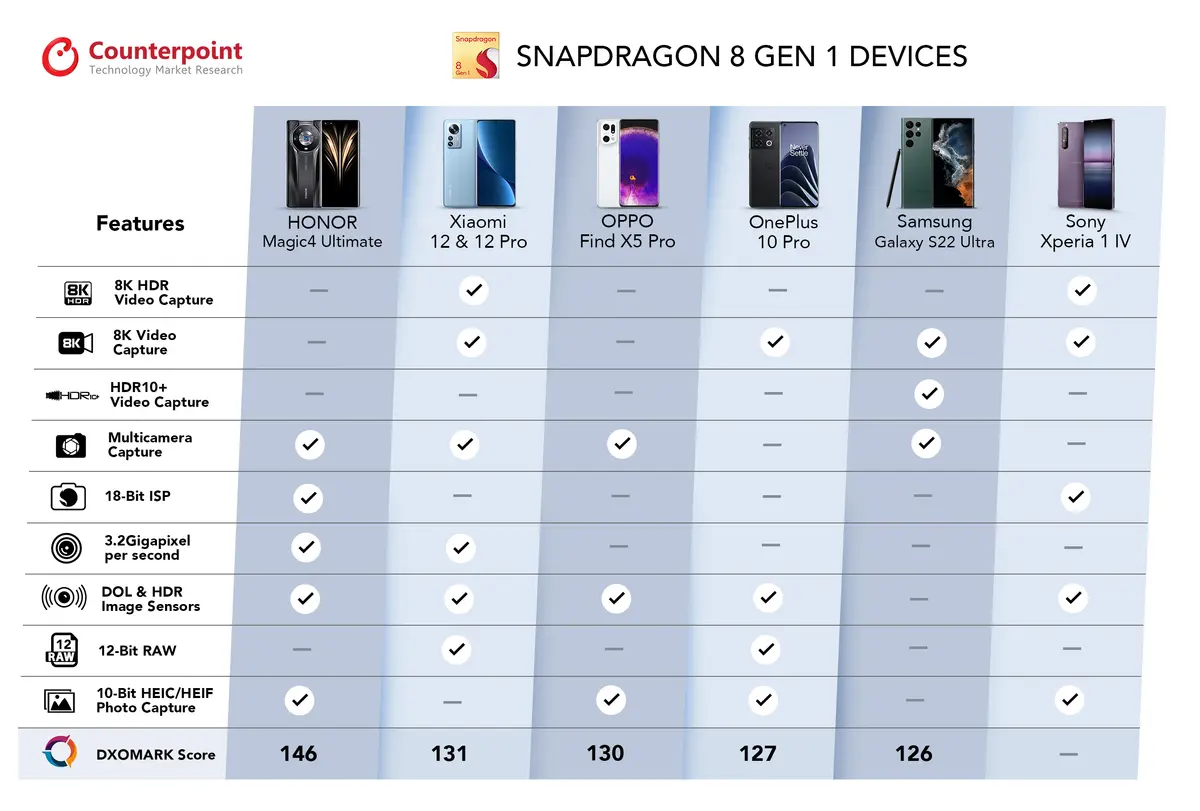
Source: Counterpoint Research Smartphone Camera & SoC Analysis, DxOMark
Some examples of collaboration between OEMs, sensor suppliers, ISVs and Qualcomm to unlock premium camera capabilities from the CV-ISP engines from software to sensors:
Honor Magic4 Ultimate
- The HONOR Magic4 Ultimate powered by Snapdragon 8 Gen 1 with 18-bit ISP and Mega Multi-Frame (MMF) engine enables 10-Bit HEIC photo capture for advanced photography experiences.
- Qualcomm Spectra ISP with Super-Resolution Engine (SRE) also supports high throughput for multithreading and parallel processing, enabling innovative user experiences such as advanced snapshot capturing capabilities while recording 4K videos.
Counterpoint’s Strategic Review of the flagship HONOR Magic4 Ultimate is here
Xiaomi 12 Pro
- Xiaomi has focused on leveraging the Super Resolution Engine (SRE) to offer 8K HDR and computational HDR10+ video capture, taking full advantage of the 3.2 Gigapixels pipeline.
- The Xiaomi 12 Pro features the 1/1.28” 50MP Sony IMX707 sensor, which is intimately optimized with Snapdragon 8 Gen 1 thanks to the Qualcomm-Sony partnership to offer super-high-resolution details, sharpness, and uniform color.
- Xiaomi also leverages Sony DOL-HDR and Snapdragon 8 Gen 1 dedicated ISP’s Mega Multi-Frame Engine and Dense Motion Map Engine (DMM) to capture several exposures simultaneously and improve low light and ghosting caused by moving objects.
OnePlus 10 Pro
- OnePlus 10 Pro features 10-bit HEIC photo capture and 8K video, 4K video @120fps, and Slo Mo capture using Snapdragon’s Super-Resolution Engine (SRE).
- OnePlus 10 Pro sports Sony IMX789 and 12-bit RAW shooting via the Hasselblad Pro mode to enable computational photography elements.
- OnePlus 10 Pro also leverages Ultrawide or Geometry Correction Engine (GCE) for supporting 150-degree ultrawide view and less distorted edges.
With the new Qualcomm Snapdragon 8+ Gen 1, we see a new wave of flagships such as Xiaomi 12S series, Samsung Galaxy Z Fold 4. Galaxy Z Flip 4, OnePlus 10T, Realme GT2, Moto Edge30 Ultra and so forth in H2 2022 to build unique camera experiences on many of the above capabilities. Watch this space for more reviews on these latest devices from the Counterpoint Labs.
Key Takeaways
The camera has become the key differentiating factor for most smartphone OEMs. They adopt a wide set of imaging, video and AI capabilities available in the chosen SoC to differentiate themselves from the competition. The chosen capabilities are then tuned well with the camera sensor and modules, and optimized via software algorithms. Despite using the common Qualcomm Snapdragon 8 Gen 1 platform, there are a plethora of capabilities that these different OEMs can leverage to compete and differentiate, making the platform and the entire stack very versatile.
Qualcomm is undoubtedly leading this space with its system-level SoC capabilities to drive premium innovations and deliver “industry-first” and advanced camera experiences. Further, OEMs also have been astute in striking key partnerships with imaging IP companies such as Dolby, Leica, Carl Zeiss and Hasselblad to differentiate on top of these cutting-edge features made available via the Snapdragon flagship chipsets. We don’t see this trend stopping anytime soon.


