With China issuing 5G licenses to telecom and broadcast companies just days before MWC Asia 2019, it was no surprise that the big theme at Shanghai was the next generation of cellular connectivity. The event saw demonstrations of the latest 5G-enabled technologies and applications from the likes of smart device OEMs, telecom operators, infrastructure and components providers.
For China, 5G is an essential element for national development. Over the years, China has recognized the importance of 5G to drive scientific and technological innovation, to upgrade industries, to stimulate investments, and to transform society and economy for the better. Below are the key takeaways from MWC Asia 2019 to give a better idea of how close we are to the official commercialization of 5G in China.
5G Network Deployment Status
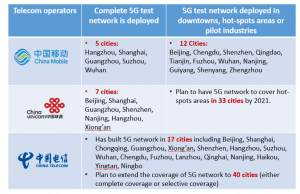
- Unlike the US, where operators focused on building a 5G Non-Standalone (NSA) network in the early deployment stage, Chinese operators have pursued a hybrid network strategy with NSA and Standalone (SA) coexisting. We expect that it will take at least five years for Chinese operators to have a nationwide coverage of 5G core (5GC), and new radio (5GC+NR) based network. Exhibit 1 below shows the current coverage of the 5G test network in China. Only selected Tier I cities in China will have complete 5G network coverage by the end of 2019.
Exhibit 1: 2019 5G network deployment in China by operators
Source: Public information, Counterpoint collects
- Operators will accelerate the construction of 5G NR and gradually migrate to separate solutions using a central unit (CU), distribution unit (DU) or active antenna unit (AAU) architecture to optimize video and gaming services further. Operators will also deploy multi-access edge computing (MEC) platforms to provide local computing, storage, and other services, to help to save the backhaul bandwidth.
- In terms of network equipment, both Huawei and ZTE have won the largest share of network equipment contracts from China Mobile and China Telecom. Besides Huawei and ZTE, Ericsson has won 12% of China Mobile’s network equipment contracts, while Nokia has won around 6%. Ericsson has also won a big contract from China Unicom valued RMB 20 billion (roughly US$2.9 billion).
- For 5G baseband and solutions, Qualcomm has won contracts from over 75 5G devices and modules OEMs/ODMs globally.
5G Devices Development Update
For consumers, 5G smartphones, customer-premises equipment (CPEs), and AR/VR glasses were the major devices showcased at MWC. China Mobile announced support for multi-modes, multi-devices, multi-choices for users, and to develop a “New Industrial Ecosystem”, will be the guideline for the company to develop its 5G device business. Key points of the operator’s 5G device strategy are as follows:
- Multi-modes: China Mobile requires smartphone models, that apply to access to its 5G network, to support both SA and NSA network standards from January 1, 2020. In 2019, prioritized access to its 5G network will also be offered to models supporting both SA and NSA.
- Multi-devices: Apart from smartphones, China Mobile is betting on the growth potential of 5G CPE and Always-Connected-PC (ACPC) from 2019-2020. Further, from 2020-2022, China Mobile will extend its 5G product portfolio to cover a wider range of accessories such as AR glasses, VR helmet, digital media streamers, and more.
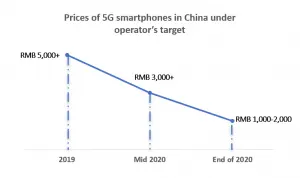
- Multi-choices for users: China Mobile will work with industrial partners to bring down prices of 5G smartphones to satisfy the budgets of users in different tiers of the market. We expect the prices of 5G smartphones in 2019 to be above RMB 5,000 (roughly US$720) in China. From mid-2020, China Mobile targets to bring down prices to RMB 3,000 (roughly US$430), and further to RMB 1,000 - 2,000 (roughly US$145-US$290) by the end of 2020.
Exhibit 2: Prices of 5G smartphones in China under operator’s target
Source: China Mobile Device Strategy 2019
- New Industrial Ecosystem: In the B2B market, China Mobile is positive on the growth potential of 5G applications in four core industries namely IoV (Internet of Vehicle), Electricity and Energy, Industrial IoT, and New Media Streaming. Key hardware that will empower the digital transformation of these industries, according to China Mobile, will be 5G connectivity hardware (for example CPEs, 5G modules), platform hardware (for example system integration, software development, 5G AI boxes), and industry-customized hardware (for example industrial robots). To accelerate industrial applications in China, the company will build an industrial products library, and try to develop generic solutions for different industries.
With 5G smartphones launching in Q3 2019, China Mobile’s new policy, which requires smartphone models to support both 5G SA and NSA standards since 2020, could hurt sales of smartphones powered by platforms supporting 5G NSA only. Huawei and its dual-brand HONOR could be the beneficiary of this policy. For marketing and consumer education, we’ve seen Huawei trying to convince the public about the benefits of smartphones supporting 5G SA network, with slogans such as “SA network is the only real 5G network”. OPPO and Vivo emphasize on cloud gaming experiences of 5G phones. They promoted technologies that can optimize users’ gaming and video streaming experiences during MWC. Such features include a 120W fast charging technology from Vivo and under-screen camera solution from OPPO.
5G Applications and Use-Cases
During MWC Asia 2019, we saw Chinese telecom operators and solutions providers showcase innovative solutions for industrial application scenarios, such as smart city, smart manufacturing, smart logistics, smart traffic, and more, powered by 5G. Below are the key examples and developments:
Smart City
Exhibit 3: China Unicom’s Smart City platform
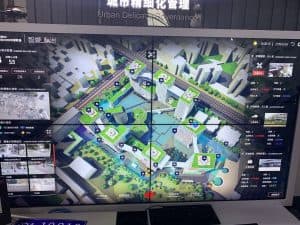
- Comprehensive governance – Using 5G HD CCTV live streaming to monitor real-time activity.
- Emergency management – Use of vehicles equipped with 5G base stations and HD cameras enables real-time situation monitoring.
- Environmental protection – Employing 5G drones to collect information and monitor protected forests, etc.
- Energy management-Collecting data from massive sensors in electricity/water/gas meters in the city to monitor and optimize energy consumption.
- Smart transportation – Enabled by deploying semi-autonomous vehicles and using C-V2X for passenger/ride safety.
- Smart policing – Using low latency 5G services to monitor and respond to public requirements.
Smart Manufacturing
Exhibit 4: China Mobile Smart Manufacturing solution for vehicles
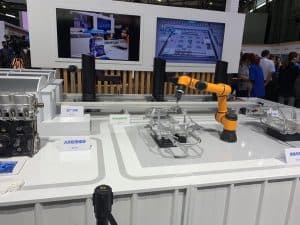
- Smart connectivity – Using URLLC 5G service to replace wired connectivity in factories and connecting the non-connected machines to achieve higher efficiency.
- Smart Assembly Process—3D camera and image recognition technologies applied to pick and send the right components to production lines under different vehicle brands and models. In quality control process, 3D camera and image recognition are also applied to tell if the components are qualified and then send the qualified components to assembly lines. Finally, robot arms and image recognition technology can automatically assemble the vehicle. The entire procedure will require a network with significant bandwidth throughput capability to continuously upload high-definition images to the cloud, as well as ultra-low latency of the network to feedback image recognition results in real time.
Others:
- Smart Healthcare – Remote surgery and health monitoring of patients via 5G network and robot arms.
- Smart Education – Use of 5G HD video to monitor students for attentiveness and send instant reports to parents.
- Smart Entertainment – The low latency of 5G technology can provide reliable AR/VR experience.
- Smart Logistics – Deploying drones and autonomous vehicles to transport goods efficiently. Use of these services can also be for analyzing the health of asset and predictive maintenance.
We expect China to officially launch 5G commercial services in Q3 2019, together with the release of 5G smartphones by key OEMs, including Huawei, OPPO, Vivo, Xiaomi, ZTE, and OnePlus. However, only selected tier-I cities can have access to the 5G network in 2019. Therefore, sales of 5G smartphones in 2019 will be limited, and it will take years for China to achieve nationwide 5G coverage. 5G will bring a more transformative impact on industrial and public sectors. Although, the complexities of 5G industrial applications mean that only highly integrated, customized, secure, and cost-for-value 5G solutions will entice industrial clients. Thus, we expect it will also take years for 5G-powered industrial solutions to mature and scale in China.
For the detailed report of MWC Asia 2019, and the latest update on 5G ecosystem in China and around the globe, please contact [email protected]
- Contact of co-author analysts:


