Memory Cost Inflation to Stall Smartphone OLED Growth in 2026 While IT OLED Segments Expand
- In 2026, smartphones are expected to be the OLED application most affected by memory cost inflation, with the forecast revised downward to flat YoY growth from prior growth expectations.
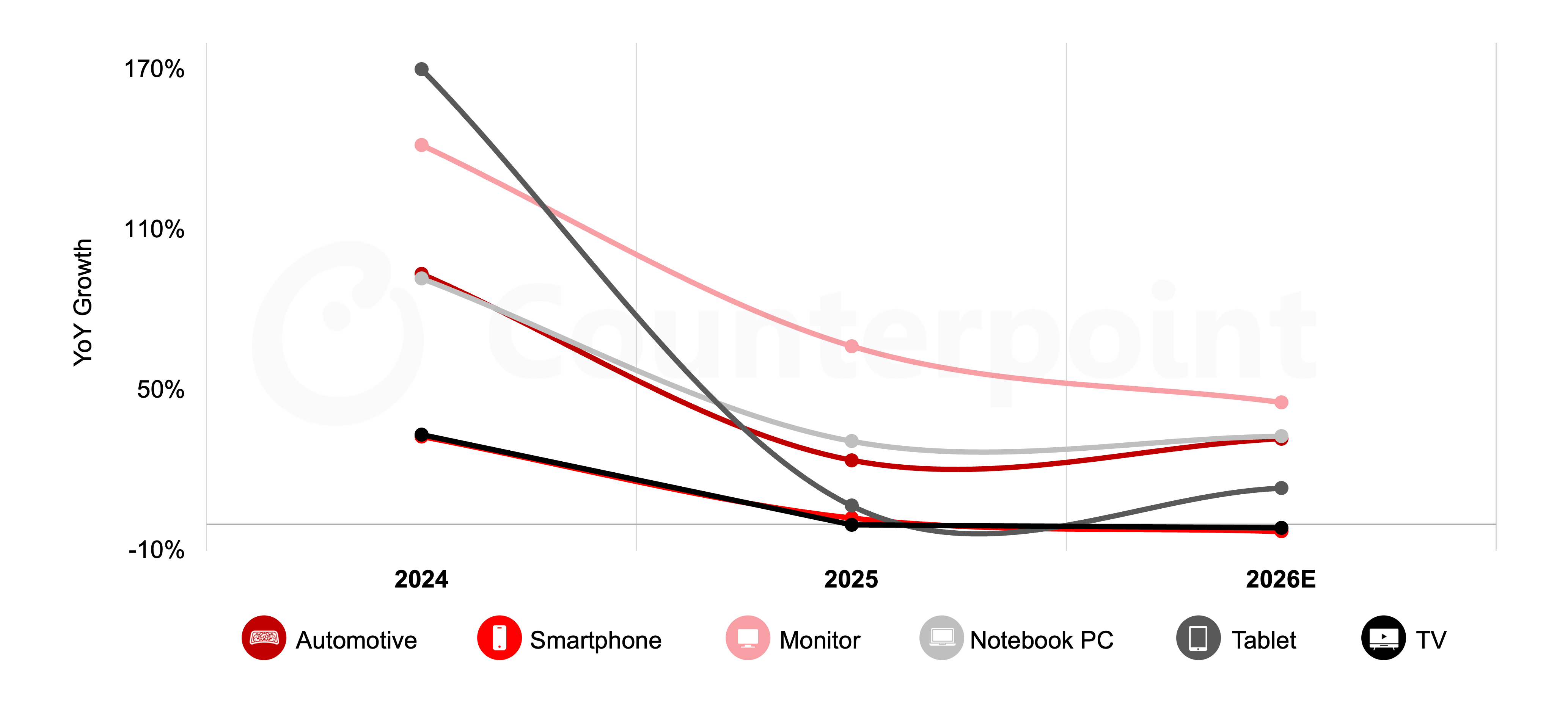
- Smartphone OLED panel shipments are projected to decline 3% YoY in 2026.
- The automotive sector is still expected to grow in 2026, but this is a downward revision from the previous forecast.
- OLED notebook PCs and tablets are expected to see increased sales volume in 2026 compared to the previous year.
San Diego, Seoul, Beijing, Berlin, Buenos Aires, Fort Collins, Hong Kong, London, New Delhi, Taipei, Tokyo – April 13, 2026
Global OLED panel shipments are projected to remain flat YoY in 2026, following a 3% YoY increase in 2025, according to Counterpoint Research’s latest OLED Shipment Report. The flat outlook is driven by a 3% YoY decline in smartphone OLED panel shipments as memory cost inflation and broader component pricing pressures constrain OEM production and demand.
“Rising memory prices are particularly impacting mid-range and entry-tier smartphones, where BOM (Bill of Materials) sensitivity is highest,” said Senior Analyst Tom Someya. “This is shifting OLED growth toward foldable and premium flexible OLED devices, while rigid OLED demand is expected to decline as OEMs rebalance portfolios and control costs.”
In contrast, growth is expected across IT-focused OLED applications, with OLED monitors projected to increase 45% YoY, tablets 13% YoY and notebook PCs 33% YoY. OLED notebook PC growth will be driven by Apple’s transition to OLED displays for MacBook Pro models and continued expansion of premium AI PCs, where higher average selling prices (ASPs) help offset rising memory costs.
The automotive OLED segment is still projected to grow in 2026, though expectations have been lowered due to component cost pressures and softer production outlooks.
OLED Panel YoY Shipment Growth by Application, 2024 – 2026E
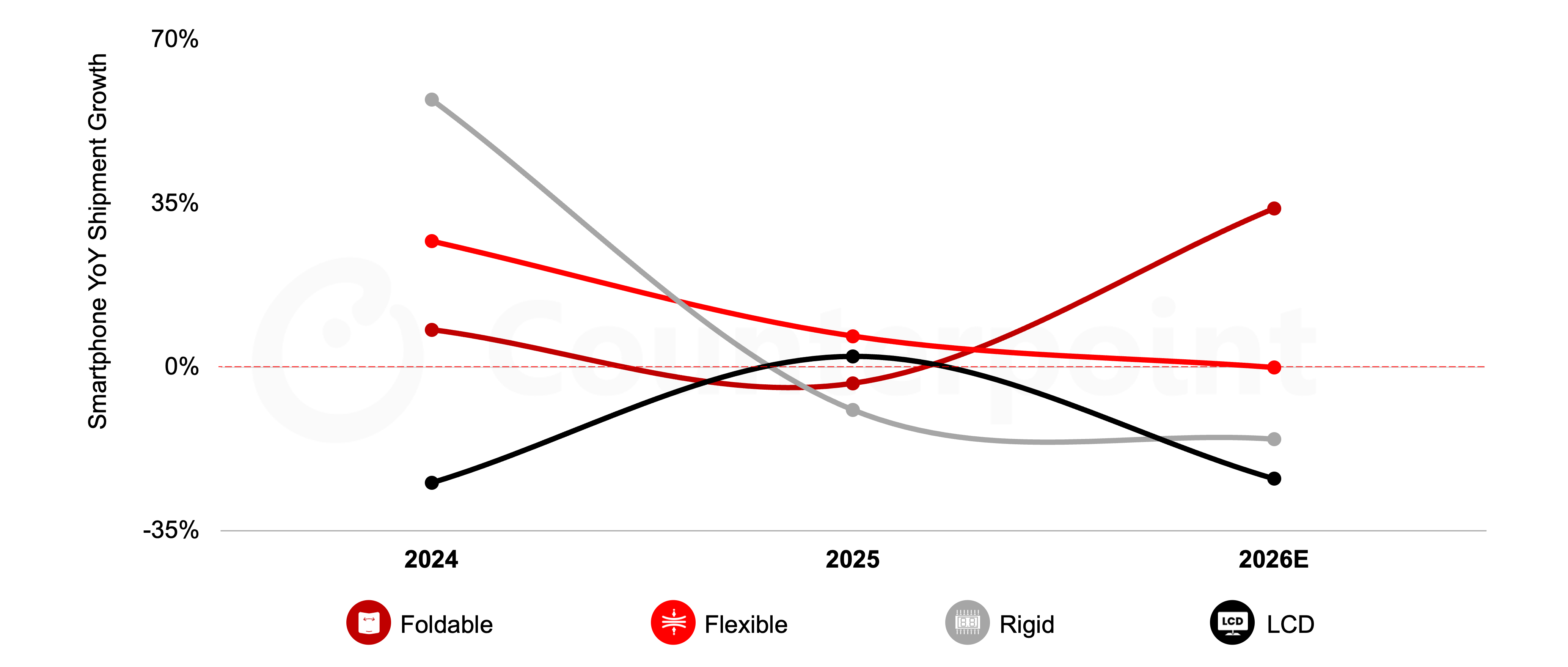
In 2026, within smartphones, foldable OLED panels are expected to grow 34% YoY, down from the prior estimate of 46%, driven by Apple’s foldable OLED smartphone and new models from Samsung and other OEMs. Flexible OLED smartphone panels are expected to remain flat YoY, revised down from the previous 2% growth forecast, while rigid OLED smartphone panels are expected to decline 15% YoY versus the prior forecast for flat growth.
OLED Smartphone Panel YoY Shipment Growth by Substrate, 2024 – 2026E
“Memory cost inflation is forcing OEMs to prioritize higher-margin devices and limit volumes in more price-sensitive smartphone tiers,” said Associate Director David Naranjo. “As a result, smartphone OLED demand is softening, while premium IT OLED applications such as notebooks and monitors continue to expand, where higher ASPs better absorb rising component costs.”
For a deep dive into the $50-billion OLED panel market, refer to our latest OLED Shipment Report, which includes quarterly tracking and forecasts for units, area, ASP, revenues, suppliers and brands by panel type across segments, including demand-side OLED product roadmaps and more.
About Counterpoint Research
Counterpoint Research is a global market research firm specializing in products across the technology ecosystem. We advise a diverse range of clients – from smartphone OEMs to chipmakers and channel players to Big Tech – through our offices located in the world's major innovation hubs, manufacturing clusters and commercial centers. Our analyst team, led by seasoned experts, engages with stakeholders across the enterprise – from the C-suite to professionals in strategy, analyst relations (AR), market intelligence (MI), business intelligence (BI), product and marketing – to deliver services spanning market data, industry thought leadership and consulting. Our core areas of coverage include AI, Automotive, Consumer Electronics, Displays, eSIM, IoT, Location Platforms, Macroeconomics, Manufacturing, Networks and Infrastructure, Semiconductors, Smartphones and Wearables. Visit our Insights page to explore our publicly available market data, insights and thought leadership, and to understand our focus, meet our analysts and start a conversation.
Follow Counterpoint Research
Receive our insightful weekly newsletter and stay ahead of the competition.
Author
David Naranjo
David Naranjo joined Counterpoint Research as part of its acquisition of DSCC, where he was Senior Director. David has more than 20 years’ experience in the consumer and commercial electronics industry. David’s professional background includes a wide range of responsibilities in product development, product planning, product management, product marketing, data analytics, and executive /operational management. Prior experience includes working in the consumer and commercial electronics industry as Director of Business Line Management at ViewSonic, Director of Product Planning at Samsung Electronics, Director of Connected Products at Kenmore, Director of Product Management at Mitsubishi Digital Electronics and Group Manager at Panasonic. David has a Bachelor of Electrical Engineering and an MBA in Finance and Marketing.
Tom Someya
Tomonori (Tom) Someya joined Counterpoint Research as part of its acquisition of DSCC. After studying marketing at Eastern Oregon University, he joined Techno Systems Research (TSR) in 2004. He was responsible for FPD and FPD materials, especially polarizing films. He published many market reports. He joined DSCC in May 2021 after working as a marketing research and strategic planning manager for one of the world's largest polarizing film suppliers since 2011. He brings more than 20 years of experience in the Flat Panel Display industry to his analysis of OLED Shipment Report and FPD Forecast Report.