
Q3 2026 Highlights
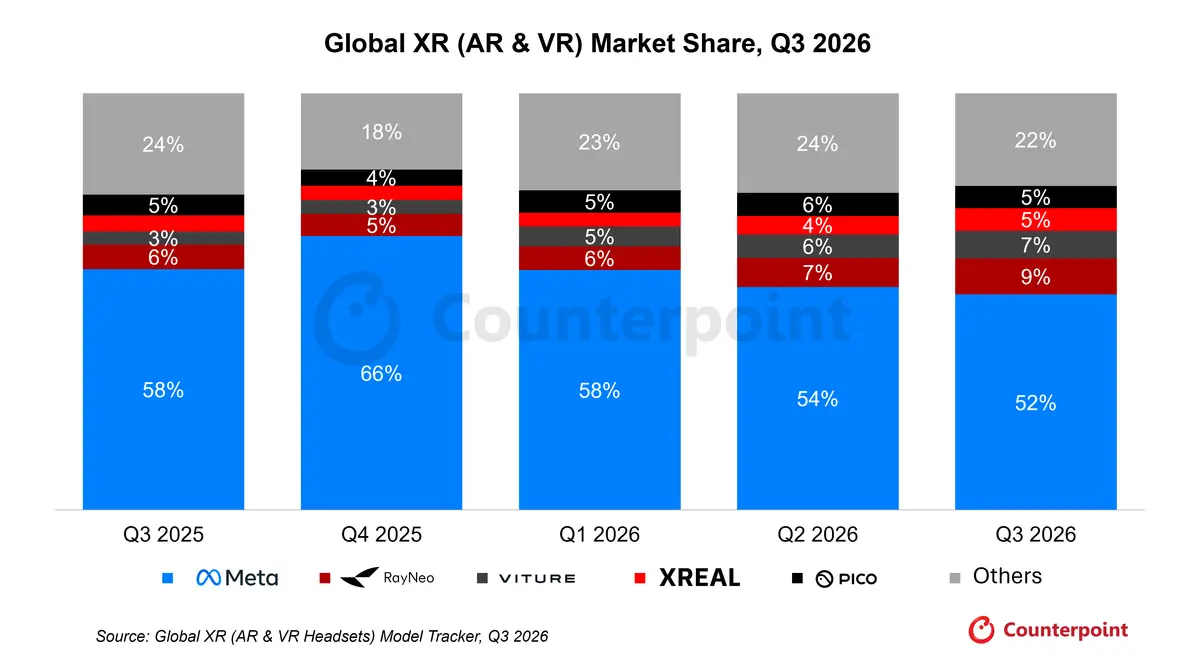
Global XR (VR & AR) Market Share
| Brands | Q3 2025 | Q4 2025 | Q1 2026 | Q2 2026 | Q3 2026 |
| Meta | 58% | 66% | 58% | 54% | 52% |
| RayNeo | 6% | 5% | 6% | 7% | 9% |
| VITURE | 3% | 3% | 5% | 6% | 7% |
| XREAL | 4% | 3% | 3% | 4% | 5% |
| Pico | 5% | 4% | 5% | 6% | 5% |
| Others | 24% | 18% | 23% | 24% | 22% |
Market Highlights
- In Q3 2026, global VR headset shipments declined by 5% YoY (year-over-year) and 10% QoQ (quarter-over-quarter). Rising component costs, higher headset prices, a lack of major new product launches and limited compelling use cases continued to weaken consumer demand. The absence of a major hardware refresh across leading OEMs also contributed to longer replacement cycles.
- Despite the broader market slowdown, the enterprise VR segment continued to demonstrate greater resilience than the consumer market. Growing adoption of VR headsets for robotics training, AI training data collection and remote robot operation, particularly in China, supported shipments of Pico and DPVR. Meanwhile, anticipated hardware price increases prompted some enterprise customers to advance their procurement into Q3, providing an additional boost to DPVR’s shipments.
- In contrast to the slowdown in VR, global shipments of AR devices surged 138% YoY and 10% QoQ in In contrast to the slowdown in VR, global shipments of AR devices surged 72% YoY and 16% QoQ in Q3 2026, driven by new product launches, international market and distribution channel expansion by OEMs, and seasonal back-to-school promotions. AR devices accounted for approximately 35% of global XR shipments, up from 23% in Q3 2025.
- During Q3 2026, Birdbath- and Flat Prism-based media-consumption AR viewers accounted for approximately 52% of the total AR device market, down from around 60% in the previous quarter. Meanwhile, the share of waveguide-based AR glasses increased to 46%, supported by the introduction of RayNeo iO and higher shipments of Meta Ray-Ban Display and Even Realities G2. This reflects growing market traction for lightweight AR glasses designed for everyday AI assistance and information display, beyond traditional media consumption and gaming applications.
- Global Q3 2026 AR/VR OEM market share rankings (based on shipments):
- Meta – 52%
- RayNeo – 9%
- VITURE – 7%
- XREAL – 5%
- Pico – 5%
- Others – 22%
*Data on this page is updated every quarter
This data represents a repository of quarterly data for the global XR (AR & VR Headsets) shipments market.
The global XR headset market share numbers are from:
Global XR (AR & VR Headsets) Model Shipments Tracker Q1 2020-Q2 2026
Excel File | Published Date: September 2026
In Q2 2026, global VR headset shipments declined by 18% YoY and 16% QoQ. Meta’s decision to increase VR headset prices amid the global memory price surge added further pressure to an already cooling market.
Read more | Contact us
Q2 2026 Highlights
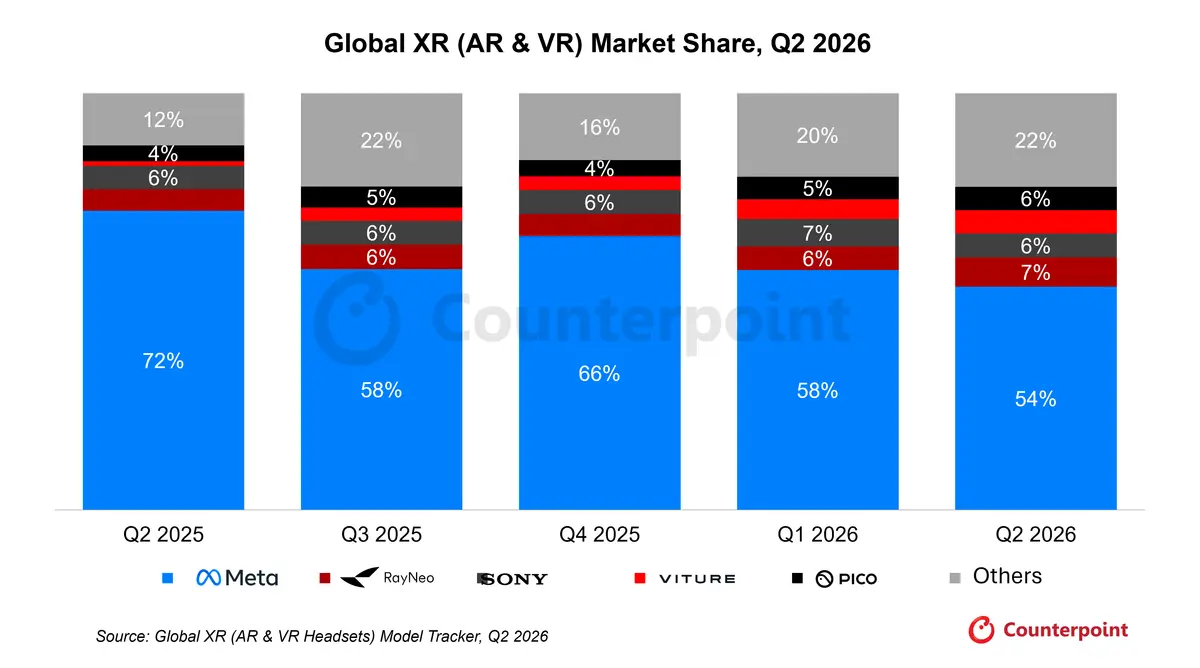
Global XR (VR & AR) Market Share
| Brands | Q2 2025 | Q3 2025 | Q4 2025 | Q1 2026 | Q2 2026 |
|---|---|---|---|---|---|
| Meta | 72% | 58% | 66% | 58% | 54% |
| Ray Neo | 5% | 6% | 5% | 6% | 7% |
| Sony | 6% | 6% | 6% | 7% | 6% |
| VITURE | 1% | 3% | 3% | 5% | 6% |
| Pico | 4% | 5% | 4% | 5% | 6% |
| Others | 12% | 22% | 16% | 20% | 22% |
Market Highlights
- In Q2 2026, global VR headset shipments declined by 18% YoY (year-over-year) and 16% QoQ (quarter-over-quarter). Meta’s decision to increase VR headset prices amid the global memory price surge added further pressure to an already cooling market.
- A relatively positive trend in the otherwise lacklustre VR market is the resilient demand from the enterprise segment. Enterprises and governments are generally less price-sensitive than consumers when adopting VR’s digital twin and spatial computing capabilities to address operational challenges and enhance productivity. Meanwhile, driven by the continued development of the robotics industry, particularly in China, demand for VR headsets used for data collection and remote robot control is expected to grow this year
- In contrast to the slowdown in VR, global shipments of AR devices surged 138% YoY and 10% QoQ in Q2 2026, driven by new product launches, international expansion by OEMs, and China’s 6.18 promotional campaigns
- During Q2 2026, Birdbath- and Flat Prism-based media-consumption AR viewers accounted for 60% of the total AR device market, slightly up from 58% in the previous quarter, driven by the launch of high-profile models such as RayNeo GT series and XREAL xbx a01+. The share of waveguide-based AR glasses stabilized at about 40% of the total AR market, up from just 20% in Q2 2025. Chinese OEMs are pioneering the commercialization of this product category. Beyond Meta, all other leading OEMs in this segment, including Rokid, Even Realities, Alibaba and iFLYTEK, are headquartered in China.
Global Q1 2026 AR/VR OEM market share rankings (based on shipments): -
- Meta – 54%
- Sony – 7%
- RayNeo – 6%
- Pico – 6%
- VITURE – 6%
- Others – 22%
*Data on this page is updated every quarter
This data represents a repository of quarterly data for the global XR (AR & VR Headsets) shipments market.
The global XR headset market share numbers are from:
Global XR (AR & VR Headsets) Model Shipments Tracker Q1 2020-Q2 2026
Excel File | Published Date: September 2026
In Q2 2026, global VR headset shipments declined by 18% YoY and 16% QoQ. Meta’s decision to increase VR headset prices amid the global memory price surge added further pressure to an already cooling market.


