

- Counterpoint estimates semiconductor revenues to nearly double from 2024 through 2030 to reach over $1 trillion.
- A key short-term driver has been the Gen AI infrastructure buildout in cloud and select edge devices.
- Longer-term evolution: Agentic AI across enterprise and consumer applications leveraging conversational, semantic search, multimedia content to Physical AI driving next decade of autonomous robots and vehicles.
- A large part of the value from infra to be unlocked longer-term from applications and APIs in the AI value chain
Seoul, Beijing, Berlin, Buenos Aires, Fort Collins, Hong Kong, London, New Delhi, Taipei, Tokyo – August 26, 2025
Global semiconductor revenues are estimated to double from 2024 to 2030 to reach over $1 trillion, driven by AI transformation to build infrastructure and consumption end points for GenAI to Agentic AI to Physical AI applications, according to new research from Counterpoint Research’s AI 360 practice titled What’s Next for AI?: How Will It Shape the Semiconductor Market?.
Global Semiconductor Revenues Forecast (In $ Billions)
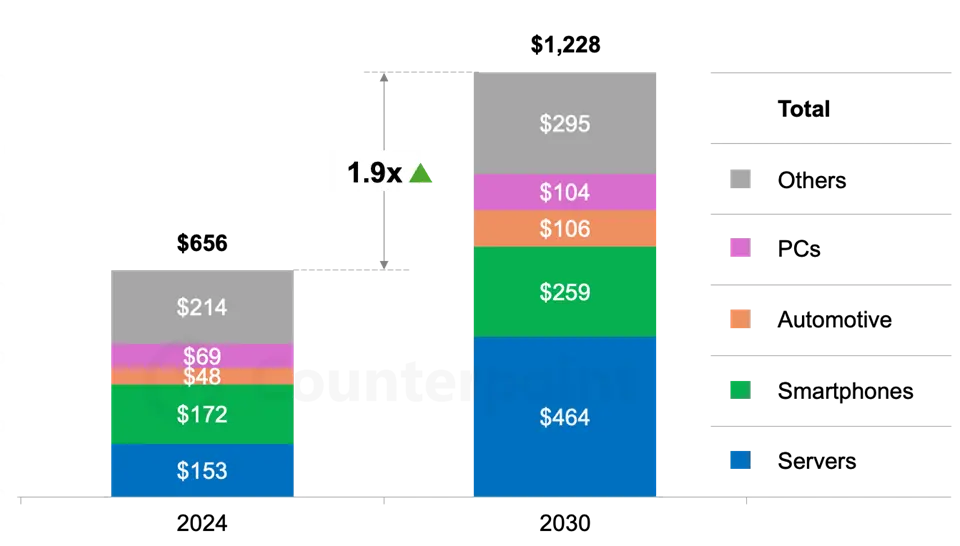
The primary catalyst will be the development of advanced AI server infrastructure, driven by sustained and potentially rapid growth in demand for forthcoming AI applications. Most of this is currently coming from hyperscalers in both the short and longer term, supporting GenAI’s path to maturity across text and, increasingly, audio and visual in the near term and Physical AI in the longer term along.
"We are witnessing the rise of ‘token economy,’ as the token becomes the new AI currency," says Neil Shah, VP of Research. "The first phase of infrastructure rollout drove an increase in token consumption as the market moved from basic text-based applications to richer, multi-modal GenAI combining text, image, audio, and video. The ongoing second phase is supporting an exponential increase in token generation for Agentic AI applications – from complex conversational AI and semantic search to fully integrated multimedia content creation. This wave will demand significant compute, memory, and networking capabilities, both in the cloud and at the edge, and the impact on semiconductor consumption cannot be overstated. The third wave will support the advent of Physical AI, enabling the rise of autonomous machines such as humanoids, industrial robots, and vehicles. This is tremendous news for the semiconductor industry, which has been laying the foundation to enable advanced AI at scale and transform lives, industries, and economies."
Currently, the bulk of AI value sits with semiconductors such as hyperscalers, Tier-2 cloud players, and enterprises rushing to build out AI infrastructure. From GPUs and accelerators, to memory (HBM, DDR) and optical interconnects, chips are the backbone of the AI economy powering everything from cloud platforms, models and frameworks to applications.
AI Value Chain Revenue Share, 2024

"In 2024, the AI market was predominantly hardware-driven, with about 80% of direct revenues coming from semiconductors for infrastructure and edge. However, that is changing," states Mohit Agarwal, Research Director at Counterpoint Research. "We are entering a new phase powered by the AI token economy, which will foster an ecosystem of applications and services similar to the mobile app economy's growth over the last decade. While the timeline for broad monetization will depend on individual and enterprise adoption rates, the immediate opportunity for value creation is clear. The most significant value to be unlocked by this next wave of AI will be substantial operational cost savings, achieved through both workforce productivity gains and widespread automation. This should help alleviate concerns about the formation of an AI monetization bubble."
Click on the link for a complimentary copy of the What’s Next for AI?: How Will It Shape the Semiconductor Market? report.
About Counterpoint Research
Counterpoint Research is a global market research firm specializing in products across the technology ecosystem. We advise a diverse range of clients – from smartphone OEMs to chipmakers and channel players to Big Tech – through our offices located in the world's major innovation hubs, manufacturing clusters and commercial centers. Our analyst team, led by seasoned experts, engages with stakeholders across the enterprise – from the C-suite to professionals in strategy, analyst relations (AR), market intelligence (MI), business intelligence (BI), product and marketing – to deliver services spanning market data, industry thought leadership and consulting. Our core areas of coverage include AI, Automotive, Consumer Electronics, Displays, eSIM, IoT, Location Platforms, Macroeconomics, Manufacturing, Networks and Infrastructure, Semiconductors, Smartphones and Wearables. Visit our Insights page to explore our publicly available market data, insights and thought leadership, and to understand our focus, meet our analysts and start a conversation.

