

- In H1 2026, global quadruped robot shipments neared 35,000 units; 40% were for industrial applications.
- Demand from vertical industries is exploding and will continuously fuel the growth of the quadruped robot industry.
- Leveraging its first-mover advantage in the entertainment and education sectors, Unitree claims the top spot in the overall market.
- In the vertical industry applications, which boasts more promising long-term growth potential, AGIQUAD and DEEP Robotics rank first and second respectively.
- Growing industrial demand and advances in embodied AI could drive the market beyond $10 billion by 2030.
Quadruped robots have long been a cutting-edge field in robotics technology R&D. As early as 2015, Boston Dynamics released a demonstration video of the Spot Classic. This motor-driven prototype was capable of stable walking in indoor and outdoor environments, jogging alongside humans, and navigating obstacles, drawing tremendous attention across the global tech industry at that time.
A decade on, the quadruped robot industry has taken a transformative leap from lab-based capability demonstrations that merely showcase technical prowess to regular deployment in real business scenarios. China stands as the core driving force behind this industrial transformation. Boasting self-developed core hardware and underlying technology stacks, and fostering an open and symbiotic industrial ecosystem, Chinese quadruped robot enterprises have gradually evolved from key market participants into leaders in technological innovation and industry standard formulation.
In 2025, global quadruped robot shipments reached 46,000 units, with the total industrial revenue approaching $700 million (including revenue from supporting hardware and software for quadruped robots). Chinese enterprises contributed over 90% of the global market share.
Global quadruped robot market sees robust growth in H1 2026
In 2026, leading quadruped robot enterprises entered a critical window for accelerated commercialization. On the one hand, they continue to deepen their layout in the cultural entertainment, education and science sectors while expanding their market footprint at home and abroad. On the other hand, technologically advanced firms are accelerating penetration into various vertical industries. Their products have achieved large-scale deployment and undertaken core operational tasks in key scenarios including security patrols, industrial inspection, fire emergency response, and logistics transportation.
In the first half of the year, global quadruped robot shipments neared 35,000 units, 40% of which stemmed from vertical industrial applications. Demand for medium and large-sized quadruped robot equipment has registered substantial growth.
Global Quadruped Robot Shipment Share by Vendor, H1 2026
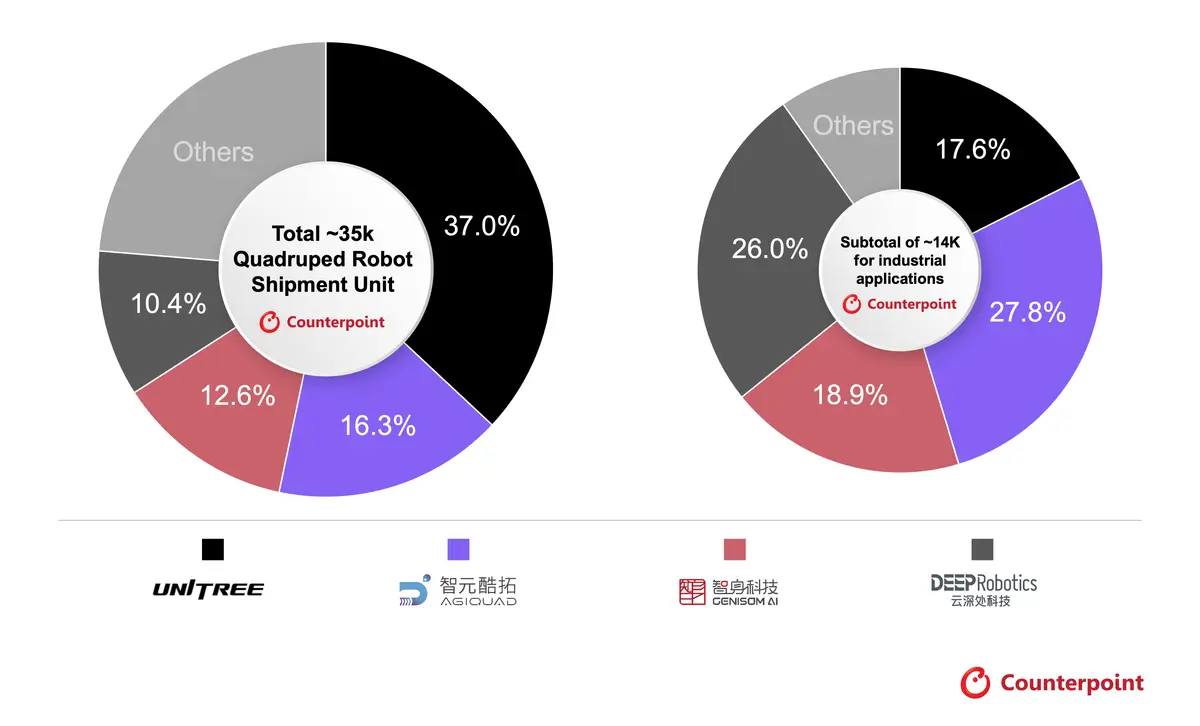
Note: The statistics exclude entry-level small from factors designed exclusively for children companion
On the vendor side, Unitree ranks first with a 37% market share. Unitree embarked on the commercialization of quadruped robots at an early stage. Centered on the entertainment and education & research tracks, it has gradually built a rich product and technology portfolio together with a relatively mature secondary development ecosystem, amassing a large global customer base in scientific research and education. Beyond its first-mover advantage, Unitree’s small quadruped robot products deliver industry-leading gross margins thanks to self-developed core hardware and motion control algorithms. Against this backdrop, entertainment and education & research applications accounted for over 70% of Unitree’s quadruped robot shipments in H1 2026. On the other hand, compared with its performance in entertainment and education & research, Unitree saw slower growth in industrial segments. Over the same period, it captured a 17.6% share of the global industrial-use quadruped robot niche market, ranking fourth.
AGIQUAD was officially founded in August 2025. Its business spun off from AGIBOT’s Lingxi product line and inherited AGIBOT’s full-stack technical capabilities. Focusing on core industrial application scenarios, AGIQUAD rapidly rolled out a complete product portfolio spanning small to medium-and-large models, making it one of the fastest-growing quadruped robot brands so far in 2026. In H1 2026, AGIQUAD secured a 16.3% overall market share. In the niche market for industrial quadruped robots, its shipment volume claimed the global top spot. By shipment breakdown, the industrial B2B market – featuring greater upside and higher unit value – accounted for nearly 70% of its total shipments, while overseas markets also made up 40% of total deliveries, leading to a diversified customer base. Powered by forward-looking product planning and market deployment, AGIQUAD’s growth is not mere scale expansion, but a simultaneous improvement in scale and quality.
Genisom AI leverages its strong capabilities in complete machine and core component manufacturing. It adopts a dual-product-line strategy with the ‘L (Gangbeng)’ and ‘M (Tongchui)’ series to expand into B2B industrial, education & research and emergency rescue application. Genisom AI posted a 12.6% shipment market share in H1 2026, ranking third globally for quadruped robot shipments. Among its offerings, the heavy-duty ‘M’ series exceeded 1,000 units in shipments, targeting high-load and complex operation scenarios such as power utilities and fire services. This demonstrates Genisom AI’s capacity to serve vertical sectors and build customized industrial solutions.
DEEP Robotics continues to concentrate on industrial tracks, taking the second position in the industrial quadruped robot niche market with a 26% share. DEEP Robotics holds a notable first-mover advantage in sectors including power utilities and fire emergency response, with a substantial roster of government and enterprise clients plus hands-on experience in project implementation and operation & maintenance. For B2B industry clients, DEEP Robotics not only supplies highly reliable quadruped robot hardware platforms but also delivers integrated industrial solutions tailored to client scenario requirements. In 2026, demand for its ‘Lynx’ series has risen markedly. Its wheel-legged hybrid design better accommodates long-distance outdoor inspection tasks, further strengthening DEEP Robotics’ competitiveness in the power inspection segment.
Exploding demand across vertical industries to drive sustained growth for quadruped robots
Currently, small-sized, low-load quadruped robots (dynamic load ≤ 20kg) boast faster commercialization progress and greater scalability thanks to their standardized chassis design. They are widely deployed in scenarios including commercial performances, scientific research and education, family companionship, lightweight security patrols, and comprehensive underground pipeline inspection. Additionally, compact small-sized quadruped robots with obstacle-crossing capabilities show considerable growth potential in emerging fields such as logistics transportation and guide dog services.
Medium and large-sized heavy-duty quadruped robots are primarily applied for inspections in complex environments such as industrial sites, power facilities, and mines. Featuring enhanced durability and higher IP protection ratings, these robots can carry an effective dynamic payload of over 20 kilograms. Serving as versatile carrier platforms, quadruped robots can be equipped with a variety of sensors including depth cameras, LiDARs, gas detectors, and thermal imaging cameras according to actual operational needs. Multi-sensor fusion enables 3D panoramic perception, AI scenario recognition and intelligent decision-making. Furthermore, functional modules such as robotic arms, laser cutting devices and wireless base stations can be installed for fire rescue and post-disaster search scenarios, diversifying on-site operational capabilities.
Of the 35,000 quadruped robots shipped in the first half of 2026, about one in five was a medium or large-sized model. As the industry’s growth momentum shifts from entertainment, culture and education scenarios to B2B vertical industrial applications, the heavy-duty industrial quadruped robot track has grown increasingly important. Meanwhile, competition among leading enterprises has evolved from a pure focus on robot locomotion performance to the delivery capability of vertical scenario-based solutions. In H1 2026, AGIQUAD achieved leapfrog growth and, together with DEEP Robotics, formed the first echelon in the heavy-duty industrial quadruped robot segment. Their flagship products include the four-legged D1 MaxPro and X30 series, as well as the wheel-legged hybrid D1 Max and Lynx M series. These robots deliver core performance required for complex operational scenarios, such as a high load-to-weight ratio, long battery life, superior protection grades and robust terrain adaptability. Equipped with abundant standardized expansion interfaces, they can integrate diverse perception and operation modules as well as self-developed industrial task software, enabling the deployment of platform-based solutions for customized vertical industrial scenarios.
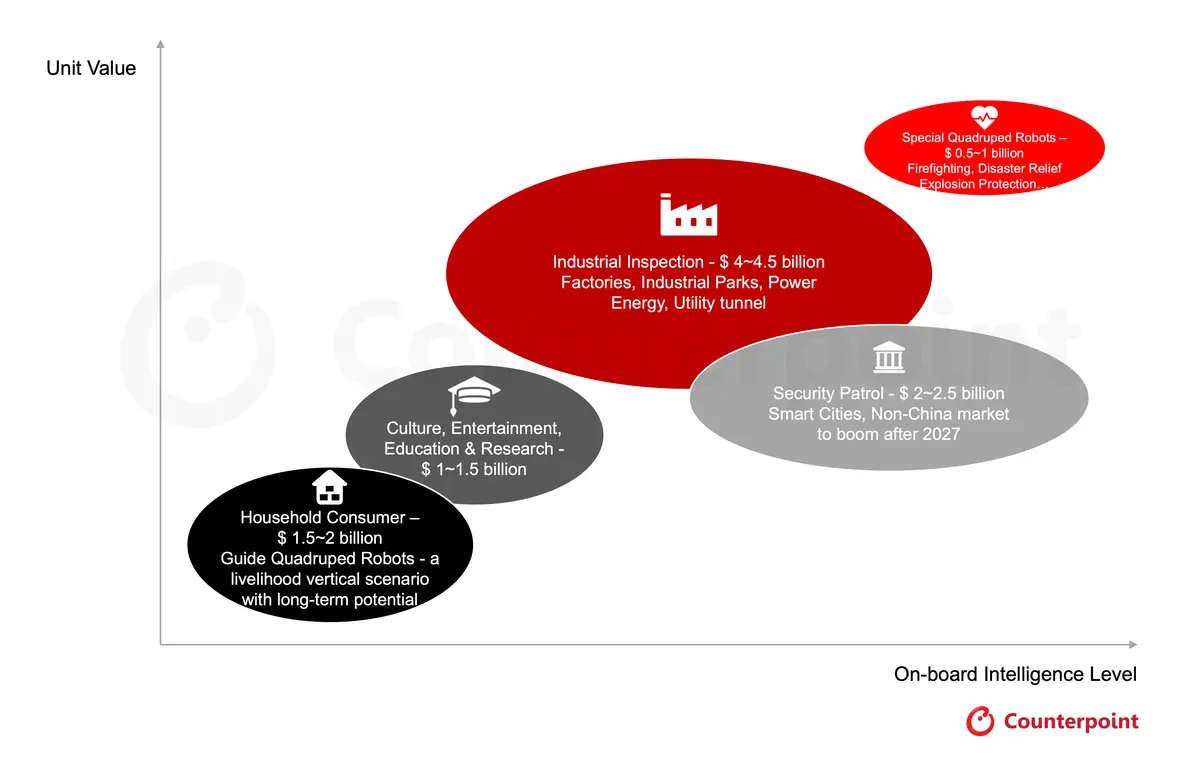
Driven by leading manufacturers’ commercial breakthroughs in industrial markets and continuous cultivation in cultural, entertainment and educational sectors, Counterpoint Research forecasts that global quadruped robot shipments will exceed 90,000 units for the first time in 2026, with annual industry revenue expected to reach $1.5 billion. Revenue generated by B2B vertical applications will continue to outperform that from cultural, entertainment and educational scenarios. In the long term, although the cultural, educational and consumer markets still hold substantial growth potential, industrial applications have become the definitive core engine driving industry expansion. By 2030, the global quadruped robot market size is projected to surpass $10 billion, representing a CAGR of over 60%, with industrial inspection and security patrols accounting for about 60% of the total market share.
Global Quadruped Robot Industry Revenue Breakdown by Application, 2030
Generalized embodied models to redefine capability boundaries of quadruped robots in the AI-native era
Against the backdrop of industrial development, perception-motion control and autonomous navigation technologies represent the key breakthrough direction. They enable quadruped robots to gain visual perception and traverse terrain with "eyes open", supporting month-long unattended inspection missions.
AGIQUAD pioneered the release of its perception-motion control engine ‘AGIQUADLoco’ and autonomous navigation engine ‘AGIQUADNav’ at WAIC 2026 in July. In September, vendors including Genisom AI and Galileo have rolled out their respective perception-motion control models one after another.
Counterpoint Research holds that intelligence is the core variable that unlocks industrial application potential and determines deployment scale. Taking power inspection as an example, current quadruped robots are mostly deployed for perception-based inspection tasks. In the long run, the industry expects quadruped robots to possess standalone operational capabilities across perception, reasoning and execution. Specifically, robots should not only autonomously identify environmental anomalies and equipment defects and report hazards but also intervene and resolve abnormal events. For instance, equipped with actuators such as robotic arms, they can perform live-line plug-and-unplug operations and replace faulty components, delivering greater value for on-site quadruped robot deployments. Intelligence has become the core evolution path for the quadruped robot industry, as well as a key enabler for enterprises to build long-term technical moats and differentiated product competitiveness.
Amid such industry developments, AGIBOT has shifted toward a platform-based R&D system. Quadruped robots, humanoid robots and dexterous hands can share AGIBOT’s accumulated expertise and cutting-edge research outcomes in embodied AI models, data management, simulation and motion control. This creates a collaborative setup where the Group undertakes frontier R&D while AGIQUAD focuses on delivering industrial scenario solutions.
Over the medium-to-long term, the evolution of quadruped robots’ technical stack will focus on layering VLA and general embodied models – the ‘brain’ – on top of the ‘cerebellar’ control layer. Robots will be endowed with multi-modal perception, spatial semantic understanding, autonomous task reasoning and professional operational skills. Their generalization ability for environmental comprehension and motion planning will be enhanced, allowing them to better tackle challenges posed by open environments and unforeseen anomalies. This addresses prominent pain points, including weak autonomous decision-making, lengthy adaptation cycles for industrial scenarios and difficult deployment under complex working conditions, accelerating the penetration of quadruped robots into industrial markets.
To learn more about Counterpoint Research’s Robotics Research Service and how it can support your business, please contact us at [email protected].

