Apple’s annual showcase on September 9, 2025, delivered a wave of next-generation hardware — highlighted by a sleeker iPhone lineup and a trio of powerful new smartwatches. Below is a full look at the most significant announcements.
iPhones: Ultra-slim design meets flagship power
iPhone 17 series
Apple introduced its 19th-generation iPhone family — iPhone 17, iPhone 17 Pro and iPhone 17 Pro Max — bringing meaningful upgrades across the board:
- 3nm A19 chip with a 5-core GPU in the standard iPhone 17
- iPhone 17 OLED display expanded to 6.27” (up from 6.12” on the iPhone 16) using an LTPO backplane versus the LTPS backplane earlier.
- Peak outdoor brightness increased to 3,000 nits from 2,000 nits on the iPhone 16 and 16 Pro.
- Enhanced camera systems for sharper photos and better low-light performance.
- Longer battery life across the lineup.
- 3nm A19 Pro chip with a 6-core GPU for the Pro models.
- All models launch with iOS 26, featuring a new “Liquid Glass” design with translucent, floating menus.
The new models also integrate Apple Intelligence, offering improved Center Stage for selfies and a new dual-capture mode that overlays the front camera feed onto main-camera video.
Pricing
- The iPhone 17 starts at $799 with 256GB of storage (up from 128GB on the iPhone 16).
- The iPhone 17 Pro and Pro Max start at $1,099 and $1,199 with 256GB of storage, matching the entry pricing of the iPhone 16 Pro models.
iPhone Air: The ultra-thin flagship
The standout reveal was the iPhone Air, Apple’s slimmest smartphone ever, at just 5.6 mm (0.22 inches). Built from spacecraft-grade titanium, it pairs a 6.55” LTPO OLED display with performance on par with the iPhone 17 series.
Key specs include:
- eSIM-only design
- Single 48MP rear camera and 18MP front camera with Center Stage and landscape selfie support
- Four colors – Space Black, Cloud White, Light Gold, Sky Blue
- Pricing starts at $999 with 256GB storage
Launch timeline and other highlights
- Pre-orders opened September 12; devices ship September 19
- Storage now starts at 256GB across the lineup
- Refined aesthetics on all models
- Full transition to eSIM-only models in Europe, removing the physical SIM tray

Smartwatches: Smarter, stronger, and more capable
Apple refreshed its wearable lineup with three new models —Apple Watch Series 11, Apple Watch SE 3, and the rugged Apple Watch Ultra 3 — each pushing forward in health tracking, durability and connectivity.
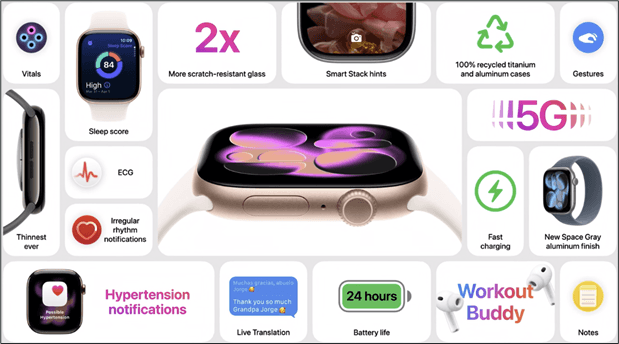
Apple Watch Series 11
- Maintains the same slim profile as the Watch Series 10, at 9.7mm.
- New health features – hypertension alerts and sleep score system
- Equipped with 5G cellular and highly scratch-resistant Ion-X glass.
- Delivers up to 24 hours of battery life, with 15-minute fast charging for 8 hours of use.
- Available in aluminum and titanium finishes with new colors.
- Pre-orders are live; ships September 19.
Apple Watch Series 11 Feature Summary
Apple Watch SE 3
- Powered by the S10 chip, supporting Always-On Display, fast charging, and new gesture controls like double-tap and wrist-flick.
- Adds health capabilities – sleep score, retrospective ovulation estimates, sleep apnea detection, and temperature sensing.
- 18 hours of battery life with reinforced Ion-X glass.
- Available to order now; shipping September 19.
Apple Watch SE3 Feature Summary

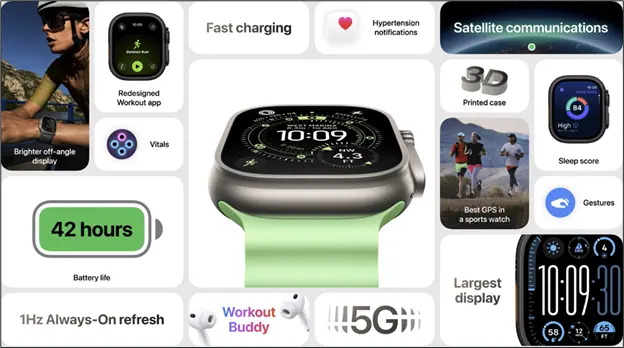
Apple Watch Ultra 3
- Designed for explorers with Apple’s largest and brightest display ever.
- Battery lasts 42 hours (up to 72 hours in Low Power Mode).
- Adds satellite connectivity for SOS messaging and offline location sharing (2 years free).
- Features 5G support, the most accurate GPS yet, and health features like hypertension notifications and sleep scoring.
- Pre-orders are open now; shipping September 19.
Apple Watch Ultra 3 Feature Summary
Analyst takes
Apple’s 2025 lineup trades headline spec leaps for mix, monetization, and ecosystem lock-in. The strategy hinges on (1) pushing LTPO (always-on display) and brighter panels across the range, (2) a 256GB floor at unchanged entry prices, (3) a new design-led “iPhone Air” at $999 to widen the premium band, and (4) deeper Apple Intelligence hooks. On wearables, Apple sharpens segmentation – thin mainstream (Series 11), value with meaningful upgrades (SE 3), and a high-margin halo product (Ultra 3) with safety and adventure features.
Supply chain and ecosystem implications
• Display stack: Broader LTPO adoption tightens capacity at premium OLED backplanes; good for panel suppliers positioned on LTPO yields.
• Materials: Titanium and ultra-thin assemblies push precision machining and coating suppliers; potential early-run yield drag.
• Services tailwind: AI features + satellite + health trending to recurring revenue hooks (storage, safety, coaching).
• Carrier dynamics: Generous promos on the base iPhone 17; watch for subsidy discipline on Air/Pro to protect margins.
Risks
• Feature parity confusion (Air vs Pro) could mute Air’s uptake if shoppers overvalue camera differences — or the opposite if design trumps specs.
• Health/regulatory: Hypertension/sleep features may see regional gating, impacting marketing claims.
• eSIM friction in the EU zone in the near term.
• Macro/China demand sensitivity remains a wildcard for unit volumes.
Bottom line
This cycle is less about breakthrough specs and more about clever price-band architecture, premium design differentiation, and AI-driven stickiness. Expect a higher blended iPhone ASP, steadier units vs 2024, and a health/safety narrative on Watch that strengthens services leverage. The iPhone Air is the wild card – if it resonates, Apple widens the premium middle and lifts margin mix without needing a Pro-class camera across the board.
