- Global smartphone shipments are now forecast to fall 13.9% YoY in 2026, dropping to 1.08 billion units, the lowest annual volume since 2013, and a steeper contraction than our February forecast of 12.4%.
- A memory supply crisis, driven by capacity reallocation toward AI-focused HBM and server DRAM, is the primary driver of the downturn, with LPDDR4/5 prices expected to treble in Q2 2026 relative to Q4 2025, per Counterpoint’s Memory Service.
- Lower-end OEMs and Emerging Markets face the sharpest pressure, with LPDDR4 memory supply tracking to a decline of over 40% in 2026; the sub-$150 segment faces an effective permanent removal in some markets.
- Apple and Samsung are the most insulated OEMs, while Huawei is the only Chinese brand expected to grow shipments in 2026.
- The Iran conflict and the closure of the Strait of Hormuz add a geopolitical dimension to the downturn, though macroeconomic headwinds are expected to be materially less severe than the post-Ukraine inflationary shock.
Seoul, Beijing, Berlin, Buenos Aires, Fort Collins, Hong Kong, London, New Delhi, Taipei, Tokyo – June 1, 2026
The global smartphone market has entered its deepest period of contraction on record, according to Counterpoint Research's latest Smartphone Market Outlook Tracker, with full-year 2026 shipments now forecast to decline 13.9% YoY to 1.08 billion units, a downward revision from the 12.4% decline projected in February. The trigger is a worsening memory supply crisis that has accelerated sharply in recent weeks, compounded by the outbreak of the Iran conflict.
Global Smartphone Forecast, May 2026 Edition
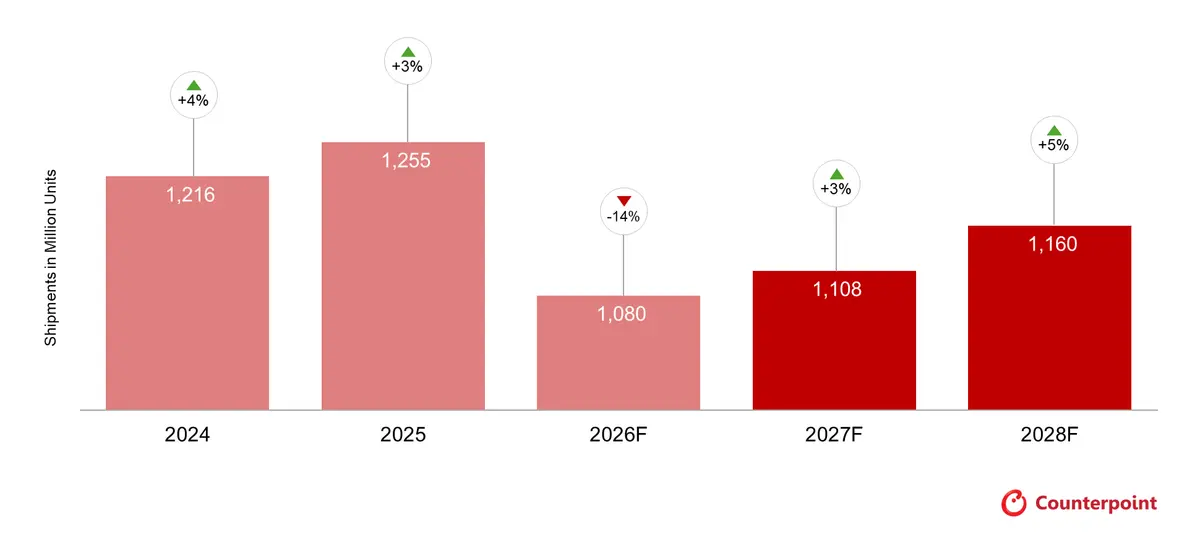
Memory crisis deepens the 2026–2027 downturn
The Q1 2026 smartphone market retreated 3.1% YoY, marking the first decline after nine consecutive quarters of growth. The performance was nonetheless better than expected, as OEMs moved to front-load shipments and clear pre-shock inventory ahead of expected price increases. However, the deterioration since has been sharp. Counterpoint Research's Memory Service indicates that mobile LPDDR4/5 prices in Q2 2026 are on track to treble relative to Q4 2025 levels, with the squeeze expected to persist through H2 2027 given the capital intensity and lead times inherent to semiconductor manufacturing.
The damage is falling disproportionately on lower-end devices. LPDDR4 supply is expected to decline more than 40% in 2026 as fabs reallocate capacity toward AI-driven HBM and server DRAM, making it increasingly uneconomical to supply entry-level products. Globally, smartphone wholesale prices rose 14% in Q1, and the pace will sustain as pre-shock inventory is exhausted. Certain sub-$150 price tiers face effective permanent ejection from the market.
Principal Analyst Yang Wang commented, “The memory crisis is the most disruptive supply-side event the smartphone industry has ever faced. Unlike demand-driven slowdowns, such as seen during COVID and 2022-23, the current contraction will not respond to pricing, channel and product planning adjustments. OEMs in the low- and mid-tier are caught between unabsorbable cost increases and consumers with hard affordability ceilings. The narrative around the smartphone market is no longer how to grow shipments or market share, but whether to remain in the market at all.”
Premium resilience, OEM divergence, and the road to recovery
The premium segment will prove more resilient, with Apple and Samsung best positioned given their integrated supply chains and established premiumization strategies.
- Apple set a March quarter revenue record in Q1 underpinned by a strong iPhone 17-driven replacement cycle. We forecast iPhone shipments to remain broadly flat in 2026, with 5% growth in 2027. Apple is in prime position to take market share from rivals due to stable memory supplies and healthy margins, making price hikes less of an urgent tactic, which will appeal to consumers.
- Samsung volumes held broadly flat in Q1 and are expected to decline only 4% in 2026, significantly outperforming the market due to stable device availability and consistent specifications across its portfolio.
Among Chinese OEMs, the picture is sharply polarized.
- Xiaomi’s 19% Q1 decline was the steepest among the top five, with full-year shipments forecast to fall 28% as the company confronts a fundamental question about economic viability in the entry-level market.
- Huawei grew 1% YoY in Q1; one of the only Chinese brands to post growth, as the company deliberately held prices to gain share in the low-to-mid tier.
- Transsion, among the most exposed OEMs given its sub-$150 concentration, is forecast to decline 32% in 2026.
Global Smartphone Forecast by Brand Market Share (2024 – 2027F)
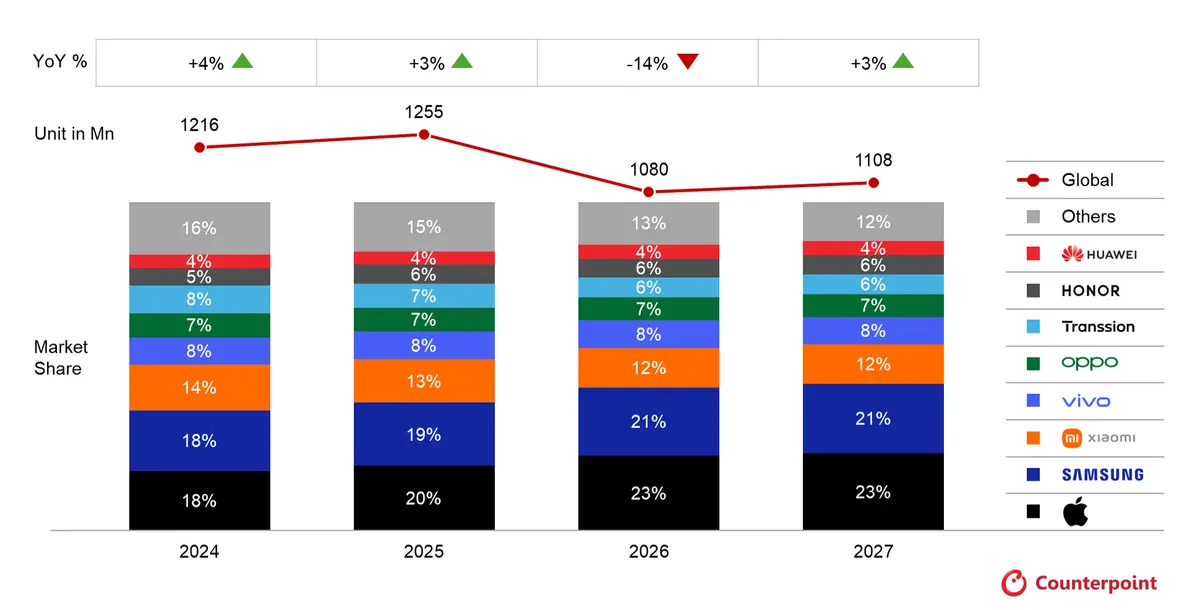
Note: vivo includes iQOO, and Xiaomi includes Redmi
Counterpoint now treats industry consolidation as a baseline scenario. On the other hand, the secondary and refurbished market will be one of the clearest beneficiaries, with growth forecast at 13% in 2026.
A market rebound is anticipated in 2028, supported by supply normalization, pent-up demand, fading geopolitical and inflationary worries, and the next major upgrade wave. The commercial launch of 6G networks in pioneer markets including China, Japan and South Korea by the end of the decade, along with the maturity of AI-native devices will provide a further catalyst.
Wang further commented, “2026 will be the year the smartphone industry’s growth assumptions were permanently repriced. The memory crisis is the proximate cause, but the deeper story is structural, with fewer brands, higher prices, longer replacement cycles, and a market that increasingly rewards supply chain control and ecosystem depth over volume ambition. The brands that emerge strongest will be those that used this crisis to sharpen their portfolios rather than simply survive it.”
About Counterpoint Research
Counterpoint Research is a global market research firm specializing in products across the technology ecosystem. We advise a diverse range of clients – from smartphone OEMs to chipmakers and channel players to Big Tech – through our offices located in the world's major innovation hubs, manufacturing clusters and commercial centers. Our analyst team, led by seasoned experts, engages with stakeholders across the enterprise – from the C-suite to professionals in strategy, analyst relations (AR), market intelligence (MI), business intelligence (BI), product development and marketing – to deliver services spanning market data, industry thought leadership and consulting. Our core areas of coverage include AI, Automotive, Consumer Electronics, Displays, eSIM, IoT, Location Platforms, Macroeconomics, Manufacturing, Networks and Infrastructure, Semiconductors, Smartphones and Wearables. Visit our Insights page to explore our publicly available market data, insights and thought leadership, and to understand our focus, meet our analysts and start a conversation.


